

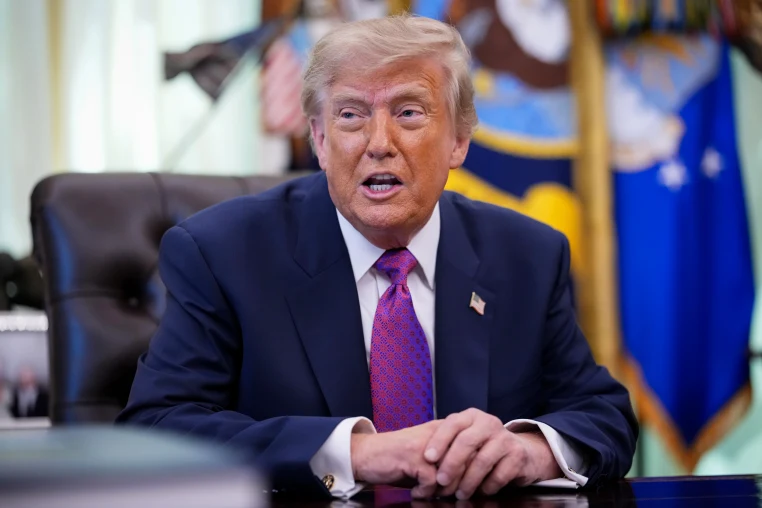
President Donald Trump has made Venezuela’s vast oil reserves the focal point of what he has referred to as the “biggest oil deal in world history”, announcing a wide-ranging new energy agreement between the United States and Venezuela.
Yet the agreement is still marked by unanswered questions.
Although Trump and Venezuela’s acting President Delcy Rodríguez have given some information regarding the proposed energy partnership, the White House has not yet made the full agreement publicly available. The absence of detailed information has left energy experts, investors and Venezuelans attempting to work out exactly how one of the world’s possibly largest oil arrangements will function.
The agreement was said by Trump to have been negotiated by Marco Rubio, the Secretary of State, and Pete Hegseth, the Defense Secretary, and Rodríguez.
For Venezuela the pact in question could be a major effort to revitalize an oil industry which has for years experienced a fall in production, a lack of investment and worsening infrastructure.
More Read
A 25-year energy partnership
Rodríguez stated that the agreement with the United States would last for 25 years and would be aimed at turning Venezuela’s huge underground oil wealth into economic development.
When speaking to people about the reconstruction efforts after the two earthquakes in late June, Rodríguez stated that Venezuela’s oil reserves should cease being nothing more than a figure on paper.
She said instead that the country’s energy resources should be used to bring about practical benefits such as housing, employment, higher wages, and better public services.
More Read

Rodríguez stated that what they were doing was for the sake of the country’s development, adding that the aim was to create more jobs and to improve access to basic necessities such as water, electricity, hospitals, schools, and food.
It is reported that the proposed agreement will include the development of 17 oil fields which have an estimated proven potential of 65 billion barrels.
Rodríguez stated that the aim is to eventually raise Venezuela’s oil production to about 1.5 million barrels per day.
A new company with access to oil for 100 years
It is reported that, under the proposed plan, the U.S. government and a private operator in Venezuela who has not been named have set up a new company with rights relating to untapped oil fields for a period of up to 100 years.
It is reportedly possible that the project could draw in as much as $100 billion for investment in Venezuela’s oil sector and produce over $209 billion in tax revenue for the Venezuelan government.
The Wall Street Journal has also stated that the American government intends to hold a 35 per cent passive stake in North American Blue Energy Partners, a company which is owned by the Venezuelan businessman Alejandro Betancourt.
Yet there remains a lack of public explanation regarding many of the details concerning the ownership structure and the financial responsibilities of the parties concerned.
It is probably going to continue to be one of the main issues about the agreement until the full version of the deal is published.
How much oil from Venezuela would the United States get?
On the basis of the information currently available, the United States will get access to 55 per cent of the new company’s effective oil production by means of its ownership interests and by being able to buy the oil at cost.
A U.S. official, who spoke anonymously since they were not authorized to speak about the matter publicly, stated that part of the oil bought by the United States could be used for strategic petroleum reserves and military requirements.
The official also stated that the new company might become the second-largest corporate holder of proven oil reserves, coming after Saudi Aramco.
But an important question still has no answer.
It has not yet become clear how much of the 55% share reported would be the result of U.S. ownership and how much would be obtained through the right to buy Venezuelan oil at production cost.
Could the agreement lead to lower prices for gasoline?
Trump has maintained that the agreement might eventually lead to lower gasoline prices for average American consumers.
However, experts who specialize in energy are doubtful that drivers will notice any immediate benefits.
Venezuela possesses some of the largest oil reserves in the world, but its production infrastructure has worsened considerably. It would take several years and billions of dollars to restore the major oil fields, pipelines and other facilities.
On Saturday the average price of gasoline in the United States was around $4.08 per gallon, as compared to about $3.20 at the same time the previous year.
Amy Myers Jaffe, who is the director of the Energy, Climate Justice and Sustainability Lab at New York University, stated that the agreement might be useful in the long term but would not have an immediate impact on gasoline prices.
Kevin Book, who is the managing director of ClearView Energy Partners, stated that Venezuela has plenty of scope to boost its production, pointing out that the country used to produce a great deal more oil than it does at present.
Yet it would take a long time to rebuild production capacity on the scale proposed by the new agreement.
It would not be felt at American gasoline stations overnight even if billions of dollars started to flow into Venezuela’s oil sector.
Why the agreement is facing criticism
The proposed deal has also drawn criticism inside Venezuela.
For many years now, control of Venezuela’s vast oil reserves has been closely linked with the nation’s national identity and political discussions. Those who criticise the new agreement claim that granting the United States such extensive access to Venezuelan oil is a major change from the country’s long-held stance on national control of its natural resources.
Some Venezuelans have openly raised the question of whether the agreement mainly serves ordinary citizens or political and business elites.
At a market in eastern Caracas, Douglas Borjas criticised the country’s leadership and said that the agreement might be linked to attempts to hold on to political power.
Ricardo Hausmann, who was previously Venezuela’s minister of planning and is now a professor at Harvard University, called the proposed arrangement a “shameful deal” and raised doubts as to whether Rodríguez had the constitutional power to commit Venezuela to such an agreement.
He also maintained that the political uncertainty connected with the deal might lead major U.S. oil companies to avoid making long-term investments.
A huge deal with an uncertain future
The announcement by Trump has generated headlines due to the large figures included in the proposed agreement.
The energy agreement could become one of the most important involving the United States and Venezuela in decades, since it would include billions of barrels of oil, possibly $100 billion in investment, and a potential partnership lasting 25 years.
The most important questions have still not been answered.
Who is going to fund the huge reconstruction of Venezuela’s oil infrastructure? Which companies are going to run the fields? What will the arrangement of ownership be like? And is the agreement going to last in the face of Venezuela’s political instability over the next few decades?
At this stage, Trump’s assertion that this could become “the biggest oil deal in world history” is still based simply on an ambitious promise and not on a fully explained public agreement.
Venezuela possesses the oil and the United States has the financial and industrial resources which could assist in restoring production. It is still uncertain whether this partnership will be able to overcome the years of infrastructure problems, political conflict and skepticism.
If the project is a success it might alter the structure of Venezuela’s oil industry and establish a new strategic energy relationship between Washington and Caracas.
However, if it fails to keep its promises the agreement might well become another instance of the difficulty of turning Venezuela’s huge oil wealth into long-term economic prosperity.