
Table of Contents
The Bengaluru-based startup Aspera Industries has launched an autonomous amphibious aircraft with the aim of making the transport of cargo quicker and much cheaper, since more and more startups are turning away from software and artificial intelligence in order to deal with major infrastructure challenges.
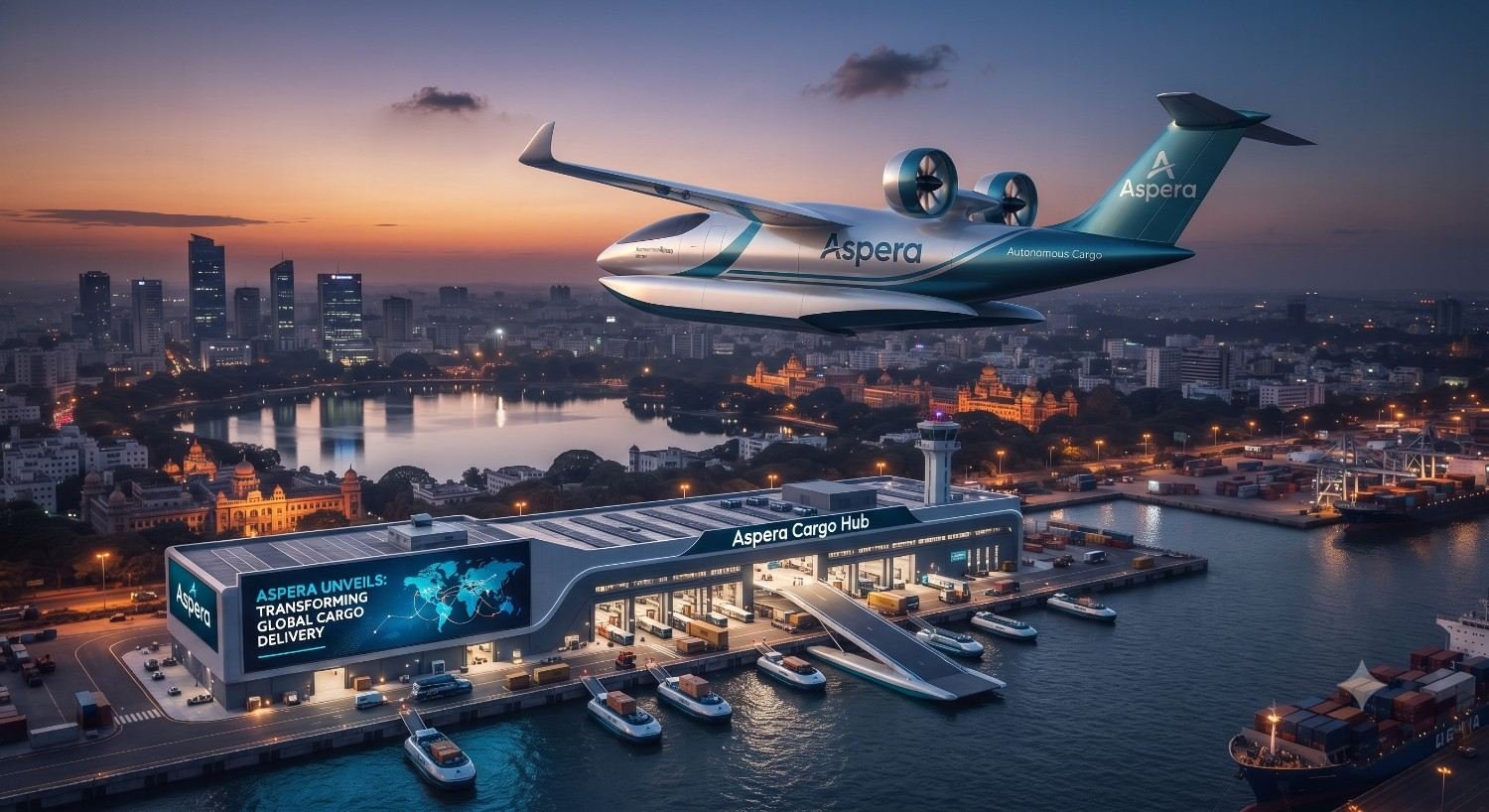
On August 29 the company revealed its first aircraft, the Eureka, stating that the autonomous seaplane is intended for cargo transport without needing conventional airport facilities.
Aspera Industries states that the Eureka will be capable of taking off from and landing on water, which will create new possibilities for the transport of cargo between coastal cities, ports and industrial areas.
The company states that its long-term aim is ambitious in that it wishes to make air cargo affordable so that it can compete with slower methods of transport for time-sensitive, valuable and perishable goods.
A Startup Takes Aim at the Cost of Air Freight
Global trade is still very dependent on ships, trucks and conventional cargo aircraft; although shipping is relatively cheap it can take weeks, whereas air freight greatly shortens the time it takes to deliver goods at a significantly higher cost.
In Aspera’s view, there is room for a new category lying between those two extremes.
Eureka can carry a cargo load of up to 1,000 kilograms and has a stated range of about 2,000 kilometres; it is also designed to operate autonomously, which may lead to lower operational costs than those of conventional cargo aircraft.
The company has stated that its aim is to achieve a cargo transportation cost of under $1 per tonne-kilometer, and it intends to lower that figure even more as its operations expand.
If the technology functions according to plan, it might provide companies with a new option for transporting time-sensitive cargo between areas where water access is easily available.
Using Water Instead of Airports
A rather unusual feature of Eureka is that it can use water when taking off and when landing.
The usual aviation infrastructure includes airports, runways, and a lot of ground facilities. The concept put forward by Aspera is that waterways could be used as an alternative kind of operating surface for cargo aircraft.
The company states that a large number of the world’s major cities, ports and industrial areas are situated close to coastlines or waterways.
Rather than constructing new airports, an amphibious aircraft might be used to link various locations by means of the existing bodies of water.
Aspera has likewise tried to overcome one of the historical problems experienced by seaplanes: aerodynamic drag.
The company states that Eureka makes use of retractable hydrofoil technology instead of depending entirely on the conventional stepped hull design found in older seaplanes. The aim is to increase efficiency when flying while at the same time keeping the capability to operate on water.
Cargo Delivery Could Move From Weeks to Hours
The announcement occurs at a time when global supply chains are still placing a higher value on speed and flexibility.
It is common for manufacturers to keep large amounts of inventory as a way of guarding against possible delays in shipping. Although quicker transport can cut down on the time that goods have to wait, standard air freight is generally too costly for a great many kinds of cargo.
The business model of Aspera is based on reducing that gap.
The company thinks that since autonomous aircraft are able to lower the cost of shipping cargo, air transport could then become viable for a far wider variety of products.
This might involve perishable goods, high-value industrial components, medical supplies and other types of shipments in which delays could result in substantial financial losses.
Nevertheless, the startup still has significant challenges to overcome before its concept can be realised on a large scale.
Big Technical and Regulatory Questions Remain
The autonomous aviation sector is still a very complicated industry.
In addition to having to design an aircraft which is capable of safely taking off from and landing on water, the companies operating in this field also have to deal with aviation regulations, autonomous flight systems, weather conditions, safety certification and international operating requirements.
Expanding an autonomous cargo fleet would also involve coordinating with ports, maritime authorities and aviation regulators.
The ultimate success of the project will come down to whether Aspera is able to show that Eureka is safe, reliable and actually cheaper than the other methods of transport.
Yet the announcement shows a trend that is becoming more common in the startup ecosystem.
Even though artificial intelligence is still the topic that dominates the headlines in venture capital, a new generation of startups is at the same time tackling tough engineering problems in the fields of aviation, energy, logistics, robotics and advanced manufacturing.
India’s Deep-Tech Startup Ecosystem Expands
The fact that Aspera has made the announcement also shows the increasing involvement of Indian startups in deep technology.
The Indian startup ecosystem has always been linked with areas like fintech, e-commerce, software and consumer technology; in recent years, though, an increasing number of founders have started to set up companies in the fields of aerospace, semiconductor design, robotics and advanced industrial technology.
Typical deep-tech startups need longer development cycles and a great deal more engineering work than ordinary software companies.
Successful companies in these industries can likewise set up completely new markets for infrastructure and technology.
The next challenge facing Aspera will be getting Eureka progress—from its current stage of ambitious engineering announcement—into actual world testing and commercial operations.
The company’s vision is simple yet possibly revolutionary in that it aims to make freight flying cheap enough for businesses to be able to avoid having to choose between slow shipping and costly air freight.
It has not yet been seen whether autonomous seaplanes can achieve that aim.
However, if the technology functions on a large scale, an aircraft developed by a startup in Bengaluru could one day play a role in changing the way goods are transported along some of the world’s most heavily used coastlines and waterways.
The development was reported on August 30, 2026.