
Table of Contents
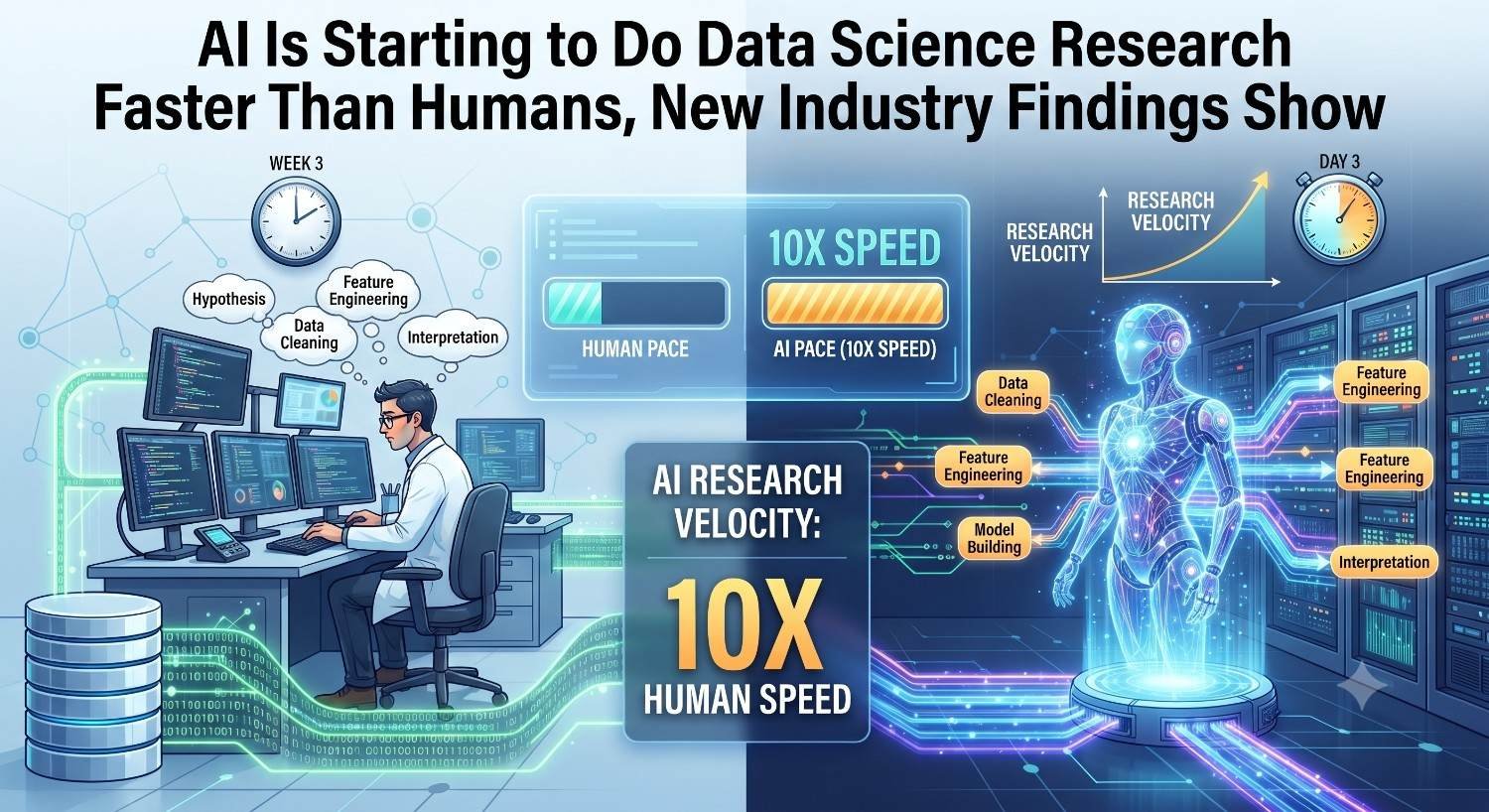
AI is no longer just being used for analyzing spreadsheets and producing charts; the most recent advances in the fields of AI and data science indicate that more sophisticated models are being employed to automate certain aspects of the research process.
In the last days of August 2026 new developments in the industry point to an increasing move towards data science powered by AI, since automated systems can assist researchers with analyzing information, testing ideas and speeding up technical workflows.
This trend could have major implications for data scientists, as well as for researchers and businesses which rely on ever more complex datasets.
Data science is becoming more automated
For many years the field of data science has combined human expertise with automated tools.
Data scientists gather information, clean the data sets, choose models, test their hypotheses and interpret the results. Although machine learning systems have helped to automate certain of these tasks, human researchers have always been in charge of a large part of the decision-making process.
That balance is starting to shift.
AI systems are at present being developed to help with ever more advanced scientific and analytical tasks. As an example, Anthropic has recently launched Claude Science, an AI workbench which is intended to combine the various tools and packages that are commonly used by researchers and at the same time produce research outputs that can be audited and grant access to computing resources.
This development is part of a wider change taking place in the industry, since AI is now becoming an integral part of the data science workflow rather than just being the focus of data science research.
From dashboards to AI-powered decision systems
A major change is taking place in the way that organizations use data.
Traditional analytics usually centered on dashboards which showed historical information; a business could look at sales figures, website traffic or customer behaviour and then ask the analysts to explain what had taken place.
Today’s AI-powered systems are being designed more and more to go further.
Rather than just providing data, AI systems are able to help detect patterns, come up with possible explanations and aid in the process of making recommendations.
The way the industry has recently been covered has brought this increasing trend towards the use of AI in analytics and automated data workflows to light, more and more companies being seen to invest in tools which combine machine learning, analytics and AI agents.
The outcome might then be a significant alteration in the role of the data scientist.
Instead of spending a lot of their time on preparing datasets and setting up repetitive analytical workflows, professionals may soon concentrate more on defining problems, assessing the results produced by AI, and making sure that the decisions taken automatically are both accurate and responsible.
AI infrastructure is becoming a data science story
The rapid growth of artificial intelligence is at the same time increasing the demand for the infrastructure required to process huge amounts of data.
Recently Nvidia has reported extremely strong demand for its AI computing technology, the data-centre sector having become a major source of revenue growth. This increase is a sign of the fact that companies in the technology industry are making heavy investments in computing systems which are capable of training and running ever more complex AI models.
For data science而言,the expansion of AI infrastructure is important since more powerful and larger systems are able to process datasets that would have been either difficult or expensive to analyze using traditional computing methods.
Yet the increasing reliance on advanced hardware also leads to new questions.
The bigger AI models become, the greater the costs organisations might have to pay for computing power, data storage and infrastructure. As a result, access to sophisticated data science capabilities could become more and more reliant on cloud providers and companies that have substantial financial resources.
AI may help scientists work faster, but humans remain essential
It does not have to be the case that the growing use of automation in research leads to data scientists becoming obsolete.
Although AI systems are capable of processing information quickly and detecting patterns in large datasets, they still require human judgment.
It has to be someone who decides which questions are worth asking.
It has to be decided whether the data is reliable.
It has to be someone who can tell when a conclusion drawn by an AI is misleading.
This is particularly important since AI systems are able to generate plausible answers even though their underlying reasoning is flawed.
Consequently, a great many experts think that the future of data science will see greater cooperation between humans and AI rather than the total replacement of human professionals.
The skills that are most valuable will increasingly involve data validation, critical thinking, statistical reasoning and the ability to judge whether or not an AI system’s output is sensible.
The rise of AI-assisted research
A major change is now the increasing use of AI tools to assist with scientific research.
AI systems are now more and more able to assist researchers in working with technical information, in automating repetitive tasks and in handling complex computational tasks.
The aim is not just to speed up existing work.
A long-term possibility is that AI could assist researchers in identifying relationships in data which humans might fail to notice.
It could have repercussions in a number of industries such as healthcare, climate research, finance, engineering and scientific discovery.
The reliability of research produced by AI will still be a major concern.
The same problems of bias, incompleteness or inaccuracy will be present in the conclusions of an AI system if it is trained on biased, incomplete or inaccurate data.
Because of this, the expansion of AI in the field of data science is likely to lead to greater importance being placed on data quality rather than less.
Data quality could become more important than ever
The more powerful AI systems become, the more organizations realize that improving the algorithms by themselves is not sufficient.
A powerful model trained on poor-quality data can still give unreliable results.
Data scientists will thus be spending more and more of their time giving attention to governance, accuracy and the source of the information used by AI systems.
Issues relating to data ownership, privacy, and bias are also becoming increasingly important.
Companies which use artificial intelligence when making decisions regarding their customers, employees or financial transactions must understand precisely how their data is collected and used.
It could turn responsible data management into one of the most valuable fields within data science over the coming years.
What this means for the future of data science
The most recent developments indicate that data science is about to enter a new stage.
The industry is now going beyond the stage at which analysts mainly used spreadsheets, dashboards and manually developed machine-learning models.
AI systems are now taking over an increasing amount of the analytical workflow, even as the demand for powerful computing infrastructure keeps on growing.
Automation is having an impact on the meaning of what it means to be a data scientist.
People who are going to become professionals will spend less time doing repetitive technical work and more time keeping an eye on automated systems, checking the results and dealing with complex problems that need human understanding.
The most significant change might still be that AI takes the place of data scientists.
Perhaps it is the case that the data scientists who know how to work effectively with AI end up being considerably more productive than those who don’t.
As AI goes on shaping the fields of research and analytics, the next phase of data science might be based on one simple notion: although machines may become better at finding answers, people will still have to decide which questions are important.