
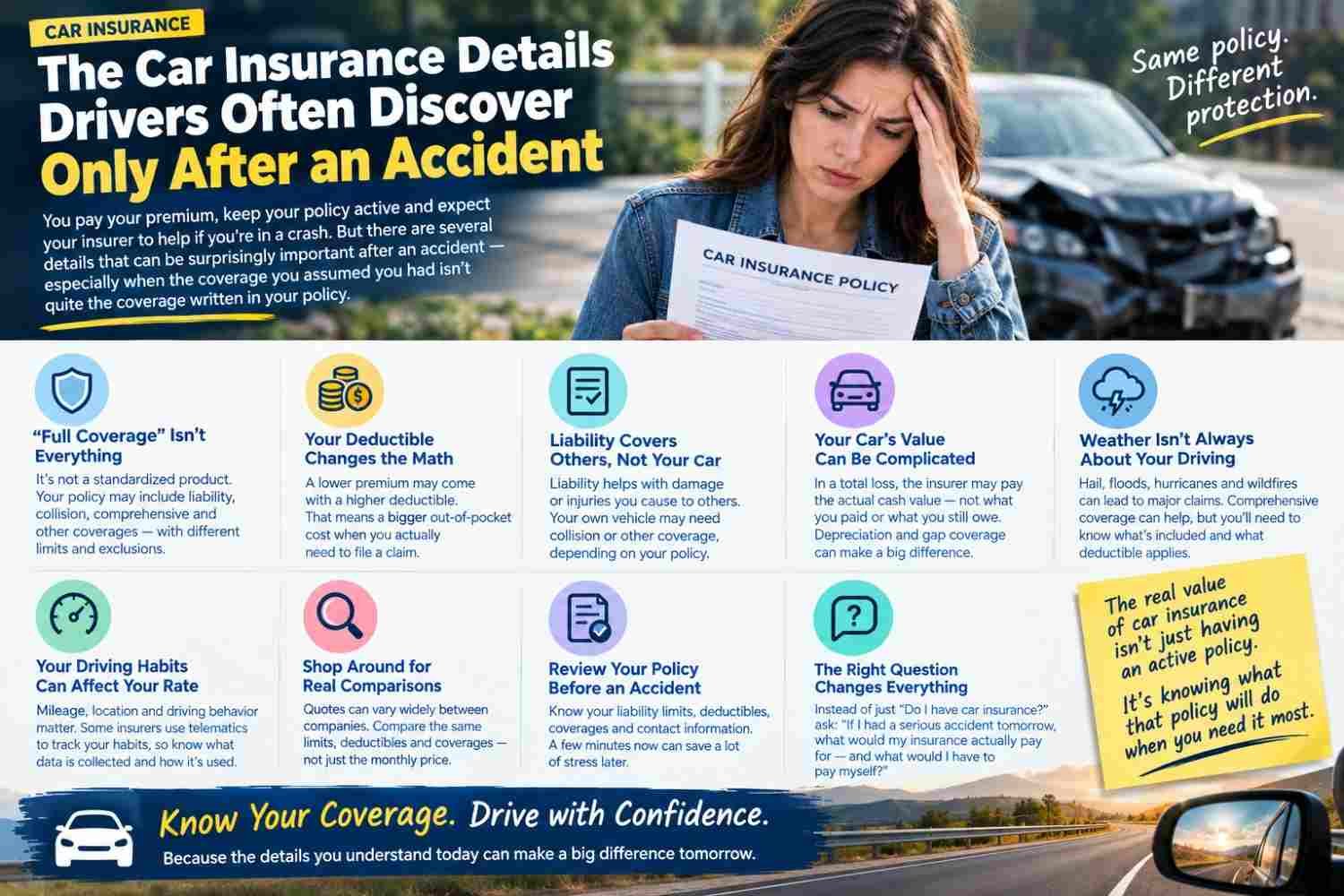
Most drivers know the basics of car insurance. You pay your premium, keep your policy active and expect your insurer to help if you’re involved in an accident. But there are several details that can become surprisingly important after a crash—especially when you discover that the coverage you assumed you had isn’t quite the coverage written in your policy.
The difference can come down to deductibles, coverage limits, liability protection, collision and comprehensive coverage, and even how the value of a damaged vehicle is determined. Understanding these details before an accident happens can make a stressful situation considerably easier to navigate.
“Full Coverage” Doesn’t Mean Everything Is Covered
Drivers often use the phrase “full coverage” when talking about car insurance, but it isn’t a standardized insurance product that guarantees protection against every possible loss. Auto policies can contain different combinations of liability, collision, comprehensive and other coverages, depending on the insurer, state requirements and policy selected.

That’s why asking exactly what your policy covers is more useful than simply asking whether you have “full coverage.” A driver may have strong protection in some areas while having limits, deductibles or exclusions that matter in another situation.
Liability Coverage Protects You From a Different Kind of Risk
Liability insurance is primarily about damage or injuries you may cause to other people, subject to the policy’s terms and limits. It isn’t the same thing as coverage for damage to your own vehicle.
This distinction becomes important after an accident. If you are responsible for damaging another person’s vehicle, liability coverage may respond to the covered loss up to the applicable limits. But damage to your own vehicle may require collision coverage or another applicable form of protection.
The exact requirements and minimum liability limits vary by state, so drivers should understand both their state’s requirements and the limits on their own policy.
Your Deductible Can Change the Financial Impact of a Crash
A deductible is the amount you generally pay toward a covered loss before your insurer pays the remaining covered amount, subject to the policy terms.
Consider a hypothetical situation where your vehicle has $5,000 in covered damage and your applicable collision deductible is $1,000. The deductible generally means you would be responsible for the first $1,000, with the insurer potentially covering the remaining eligible amount.
This is why the cheapest monthly premium isn’t necessarily the only number worth considering. A lower premium may come with a higher deductible, which could mean a larger immediate expense after a covered accident.
Your Car’s Value Can Become a Complicated Question
After a serious accident, another question can become important: How much is the vehicle actually worth?
For a vehicle that is declared a total loss, the insurer may determine the vehicle’s actual cash value according to the policy and applicable claims practices. This can be different from what you originally paid for the car or what you still owe on an auto loan.
Depreciation matters. A vehicle can lose value over time even if it has been well maintained.
This is one reason drivers who finance or lease vehicles should understand what their policy covers and whether additional products, such as gap coverage, apply to their situation.
A New Car Doesn’t Automatically Mean a New Insurance Price
Buying a newer vehicle can change your insurance costs, but the effect isn’t determined solely by the sticker price. Insurers may consider factors related to the vehicle, including repair costs, safety characteristics, theft risk and claims experience.
A vehicle with advanced safety technology may offer important safety benefits while also containing expensive components that can increase repair costs after a collision.
Before buying a vehicle, getting an insurance quote can therefore be a useful part of the purchasing process. It can prevent an unexpected insurance bill from appearing after you’ve already committed to the car.
Weather Can Matter Even If You’re a Careful Driver
You can have an excellent driving record and still face insurance costs influenced by events that have nothing to do with your driving.
Hailstorms, hurricanes, flooding, wildfires and other severe weather events can generate large numbers of vehicle claims. Comprehensive coverage can protect against certain non-collision losses, depending on the policy, but drivers should understand what their particular policy includes and what deductible applies.
This is another reason the phrase “I have insurance” doesn’t provide enough information by itself. The type of loss matters.
Your Mileage and Driving Habits Can Matter Too
How much you drive can be relevant to insurance pricing because spending more time on the road generally creates more opportunities for an accident. Insurers may ask about mileage and vehicle use when determining rates.
Some insurers also offer telematics programs that use driving data to assess driving behavior. Depending on the program, information can include mileage, braking, acceleration, speed and other driving patterns.
If you’re considering such a program, understand what data is collected and how the insurer uses it before enrolling.
Shopping Around Can Reveal a Surprising Difference
Insurance pricing isn’t identical across companies. Two insurers can offer different premiums to the same driver because companies use different rating models and underwriting approaches.
That doesn’t mean the lowest quote is automatically the right choice. A meaningful comparison requires looking at the same liability limits, deductibles and optional coverages.
If one quote is dramatically cheaper, check whether the policies are actually providing comparable protection.
The Most Important Time to Review Your Policy Is Before the Accident
The worst time to discover how your car insurance works is when you’re standing beside a damaged vehicle.
Before you need to file a claim, take a few minutes to identify your liability limits, collision and comprehensive coverage, deductibles and any important optional protections. Make sure your insurer has accurate information about your vehicle and how it is used.
You don’t need to memorize the entire policy. You simply need to understand the parts that could have a major financial impact.
The Question Every Driver Should Be Able to Answer
Instead of asking only, “Do I have car insurance?”, ask something more specific:
“If I had a serious accident tomorrow, what would my insurance actually pay for—and what would I have to pay myself?”
That answer can tell you far more about your financial protection than the monthly premium ever could.
Because the real value of car insurance isn’t just having an active policy.
It’s knowing what that policy will do when you need it most.
Table of Contents