Table of Contents
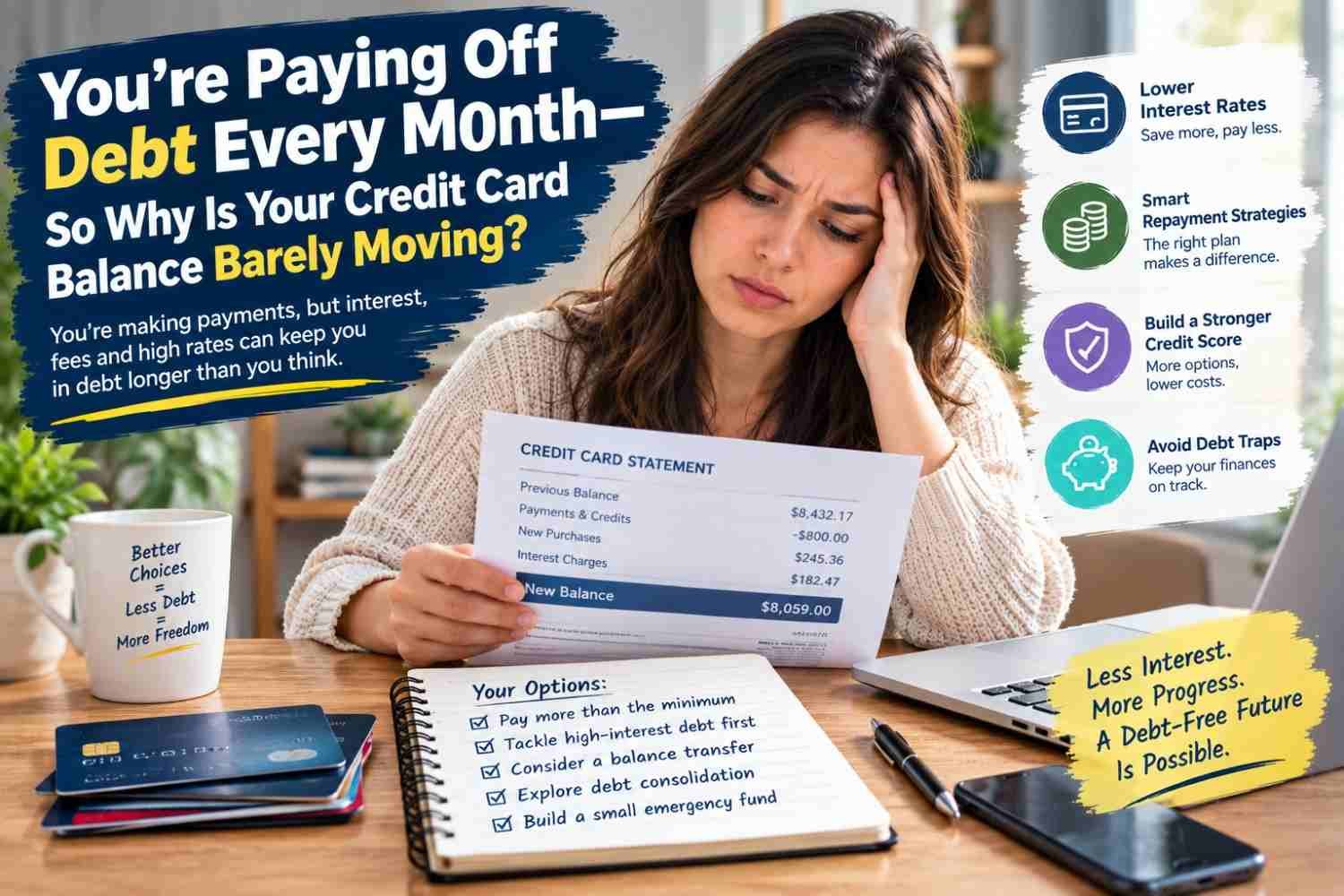
You’re making payments toward your debt every month, yet when you check your credit card balance, it can feel like almost nothing has changed. You may even be paying more than the minimum, but high interest charges can consume a significant portion of your payment before much of it actually reduces what you owe.
That experience is surprisingly common, especially when a large balance is carrying a high interest rate. The problem is not necessarily that you are failing to make payments. It is that interest can consume part of each payment before much of the money reaches the principal balance.
Once you understand how that works, the path out of debt becomes much easier to see.
The good news is that there are several strategies consumers can consider, from changing the way payments are allocated to evaluating balance transfers, consolidation, refinancing, or simply attacking the most expensive debt first.

The Minimum Payment Can Keep You in Debt for a Long Time
Credit card minimum payments are designed to keep an account current, not necessarily to eliminate the balance quickly.
If you have a large balance and a relatively high annual percentage rate, making only the minimum payment can result in substantial interest charges over time. A payment that looks manageable on your monthly statement can therefore leave you carrying the balance for much longer than expected.
This is why the minimum payment should not be confused with a recommended payoff strategy.
Your statement may show how much you need to pay to remain current, but that number does not necessarily tell you how quickly you can become debt-free.
Interest Is the Part of the Payment You Don’t See
Imagine that you owe $10,000 on a credit card.
The exact amount of interest charged depends on your annual percentage rate, balance, billing cycle, and the card’s terms. But the basic concept is simple: interest accumulates based on the outstanding balance and applicable rate.
That means every month you carry the balance, some of your payment may effectively be paying for the cost of borrowing rather than reducing what you originally spent.
As the balance falls, the interest cost can eventually fall as well. But getting the balance down in the first place can be difficult when a significant portion of your payment is being consumed by interest.
This is why reducing the interest rate can sometimes be just as important as increasing the monthly payment.
Your Interest Rate Could Be the Biggest Problem
Not all debt costs the same.
A mortgage, auto loan, student loan, personal loan, and credit card can have very different interest rates and repayment structures. Even two credit cards can charge dramatically different rates.
If you have several balances, it can be useful to identify which debts are costing you the most.
A $5,000 balance at a relatively high rate can potentially be more financially urgent than a larger balance carrying a much lower rate, depending on the terms.
This is one reason many debt-repayment strategies focus on the interest rate rather than simply the size of the balance.
The Debt Avalanche Method
One popular approach is the debt avalanche method.
You continue making the required payments on all your debts while directing extra money toward the debt with the highest interest rate. Once that balance is eliminated, you move the extra payment to the next-highest-rate debt.
The advantage is mathematical: reducing the balance that is costing you the most interest first can potentially reduce the total interest paid over time.
It can be especially appealing to people who are comfortable waiting for the psychological satisfaction of eliminating an entire balance.
But there is another strategy that works differently.
The Debt Snowball Method
The debt snowball method focuses on balance size rather than interest rate.
You make required payments on all debts but direct extra money toward the smallest balance first. Once that balance disappears, you take the money you had been paying toward it and add it to the next-smallest balance.
The potential advantage is behavioral.
Eliminating a small debt can create an immediate sense of progress. That psychological momentum can make it easier for some people to remain consistent with a debt-payoff plan.
The avalanche method may minimize interest more efficiently in certain situations, while the snowball method may be easier for some people to stick with.
The best strategy is ultimately the one you can actually follow.
What About a Balance Transfer?
A balance transfer can look extremely attractive when you are dealing with high-interest credit card debt.
Some credit cards offer promotional periods during which qualifying transferred balances receive a lower interest rate, sometimes even a 0% promotional APR for a limited period. However, these offers typically have specific terms, eligibility requirements, and potential fees.
The promotional period also matters.
Moving a balance to a lower-rate card does not make the debt disappear. It changes the cost and potentially gives you a window in which more of your payment can go toward reducing the balance.
Before accepting an offer, check the transfer fee, promotional period, post-promotional APR, minimum payment requirements, and other terms.
A balance transfer can be useful in the right circumstances, but it should be treated as a repayment tool—not an excuse to continue accumulating new debt.
Debt Consolidation Can Simplify Your Finances
Another option consumers sometimes consider is debt consolidation.
Instead of managing several separate balances, a borrower may use a new loan or another financial product to combine some existing debts into one payment.
The appeal is obvious: one payment can be easier to track than several.
But consolidation only makes financial sense if you understand the complete cost. A lower monthly payment does not necessarily mean you are paying less overall. The new loan could have a longer repayment period, fees, or other costs that change the total amount paid.
Always compare the interest rate, fees, repayment term, monthly payment, and total repayment cost rather than looking only at the new monthly bill.
Be Careful With “Lower Monthly Payment” Offers
A lower monthly payment sounds good.
But there are two very different ways to reduce a payment.
You could reduce it because the interest rate is lower and the debt is becoming cheaper to repay.
Or you could reduce it because the repayment period has been stretched much longer.
The second situation can sometimes result in paying more interest over the life of the debt despite having a smaller monthly obligation.
Whenever someone offers to lower your payment, ask a second question:
“How much will I pay in total before this debt is completely gone?”
That number can tell you much more than the monthly payment alone.
Don’t Ignore Your Credit Score
Debt and credit scores can influence each other, particularly when credit card balances become large relative to available credit.
Credit utilization is one factor commonly considered in credit scoring models. Carrying high balances can therefore affect your credit profile even if you are making payments on time.
This creates another reason to work toward reducing revolving debt.
However, paying down debt should not be viewed solely as a way to increase your credit score. The more important financial benefit is reducing what you owe and potentially reducing the interest you pay.
A higher credit score can be useful, but becoming less dependent on expensive revolving debt can have a much larger impact on your overall financial position.
Don’t Close Every Credit Card After Paying It Off
Paying off a credit card can feel so good that you may immediately want to close the account.
That is not always necessary.
Closing an account can affect your available credit and potentially change aspects of your credit profile. The right decision depends on the card, its fees, your spending habits, and your ability to avoid accumulating new debt.
If a card has an annual fee or creates a temptation to overspend, closing it might make sense in some situations.
But if you can keep the account responsibly without paying unnecessary fees, there may be reasons to leave it open.
The important thing is not to confuse having available credit with having money to spend.
Stop the Balance From Growing Again
Paying off debt is only half of the problem.
The other half is preventing the same balance from returning.
If you use a credit card to pay off an old balance and then continue charging expenses that you cannot afford to repay, you can end up with both the new repayment obligation and new credit card debt.
That is why a debt plan should include a spending plan.
Look at the expenses that originally caused the balance to grow. Was it an unexpected medical bill? An expensive car repair? Everyday spending that exceeded income? A temporary loss of income? Or simply a pattern of relying on credit for purchases?
The answer matters because different causes require different solutions.
Build a Small Cash Buffer While Paying Debt
It can seem counterproductive to save money while you still owe money.
But having absolutely no cash available can create a dangerous cycle.
Suppose you pay every available dollar toward your credit cards and then your car suddenly needs a $1,500 repair. Without savings, you may have no choice but to put the repair back on a credit card.
A modest emergency reserve can provide some protection against that situation.
The appropriate amount depends on your income, expenses, job stability, household situation, and existing savings. The goal is not necessarily to build a huge cash reserve before making any debt payments. It is to avoid being so financially fragile that every unexpected expense creates new debt.
Watch Out for Debt-Relief Scams
When people are struggling with debt, they can become targets for aggressive or misleading financial offers.
Be cautious about companies that promise to eliminate your debt quickly, guarantee a specific credit-score improvement, or demand large upfront fees without clearly explaining what they will do.
Debt settlement, credit counseling, consolidation, and other forms of assistance are not interchangeable. They can have different costs, risks, eligibility requirements, and consequences.
Before entering any debt-relief program, understand exactly what happens to your accounts, how creditors are contacted, what fees you will pay, and how the strategy could affect your credit.
If an offer sounds too good to be true, slow down before handing over personal financial information.
What If You Have Multiple Types of Debt?
Many households do not have just one debt.
You might have a credit card balance, auto loan, student loan, personal loan, and mortgage at the same time.
That does not necessarily mean you should treat them equally.
Make a list showing:
- Current balance
- Interest rate
- Minimum payment
- Remaining repayment term
- Any fees or penalties
- Whether the rate is fixed or variable
- Whether the debt is secured or unsecured
Seeing everything in one place can make the situation feel much less overwhelming.
You may discover that one balance is dramatically more expensive than the others.
The Highest Interest Rate Deserves Attention
If your goal is to reduce the financial cost of debt, the interest rate deserves serious attention.
Consider two hypothetical debts:
Debt A: $3,000 at 29% APR
Debt B: $10,000 at 7% APR
Debt B is much larger, but Debt A is considerably more expensive relative to the amount borrowed.
That does not automatically mean every borrower should pay Debt A first. Cash flow, tax considerations, loan terms, penalties, and personal circumstances can change the decision.
But it demonstrates why simply ranking debts by balance can sometimes give you the wrong priority.
Don’t Forget to Check Your Credit Report
If you are actively working on debt, reviewing your credit reports can help you understand what creditors are reporting.
Look for accounts you do not recognize, incorrect balances, inaccurate payment information, or other errors.
Consumers can access their credit reports through the federally authorized AnnualCreditReport.com website.
Checking your report also gives you a clearer picture of how many accounts are open and what information lenders may see.
A Debt-Free Future Starts With One Balance
Getting out of debt rarely happens because someone discovers one magical financial trick.
It usually happens through a combination of several relatively simple decisions: understanding the interest rate, stopping unnecessary borrowing, making consistent payments, targeting expensive debt, and avoiding new balances.
The first few months can feel slow.
Then something changes.
One balance reaches zero.
The payment that used to disappear into that account can now be redirected toward another balance. The process begins to accelerate.
Eventually, the money that once went toward interest and debt payments can start working toward something else—an emergency fund, retirement savings, a home, investments, or another financial goal.
The Goal Isn’t Just to Owe Less
The real goal of debt repayment is not simply seeing a smaller number on a statement.
It is creating more control over your money.
Every dollar that no longer has to go toward expensive interest gives you another dollar that can potentially be directed toward your future.
If you are carrying debt today, you do not necessarily need to solve everything at once. Start by understanding exactly what you owe, what each debt costs, and which balance deserves your attention first.
Then choose a strategy you can maintain.
Because the most powerful debt payment is not necessarily the biggest one you make once.
It is the payment you can keep making until the balance finally reaches zero.