
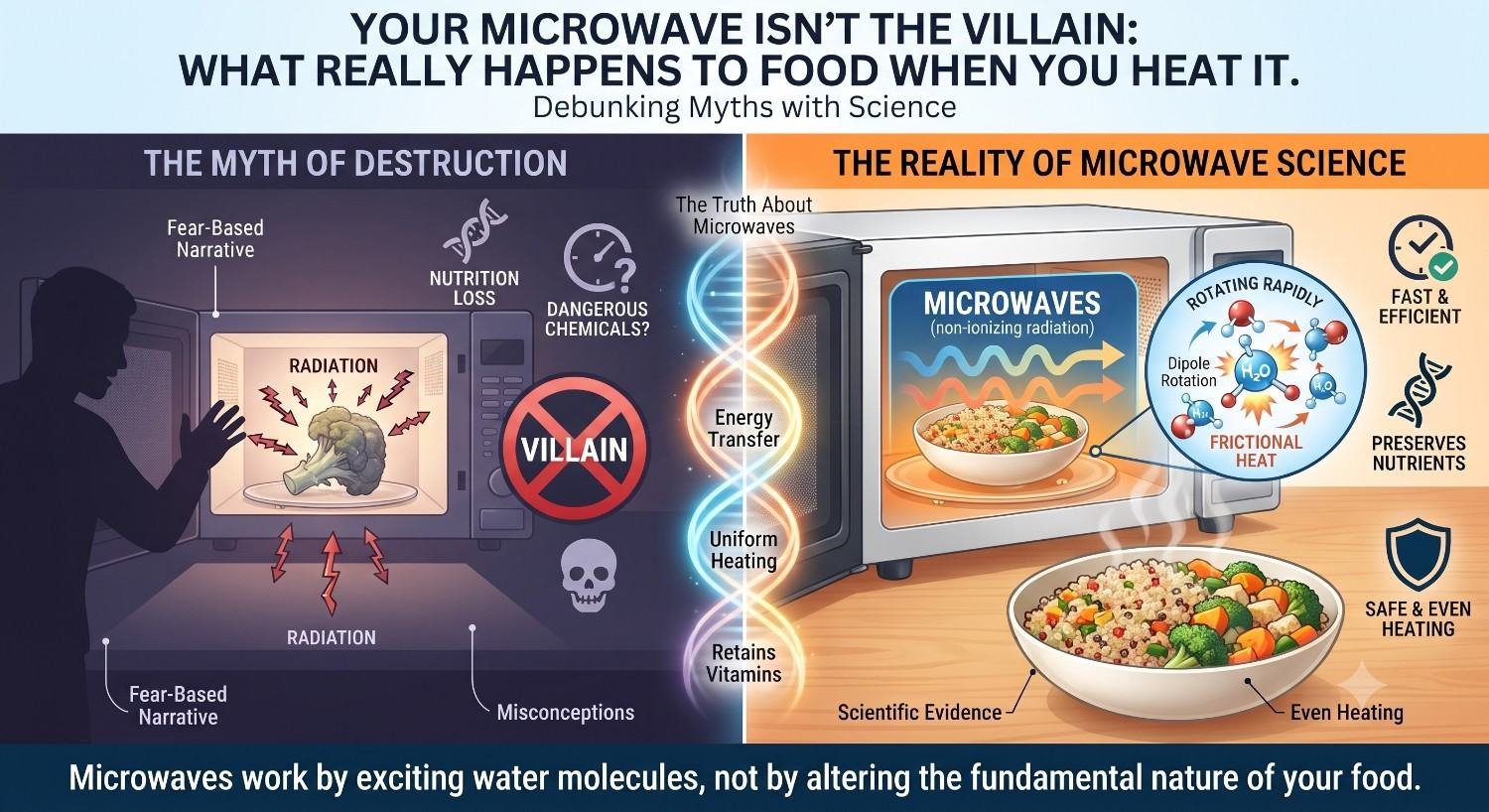
Microwave ovens are now one of the most commonly found appliances in modern kitchens, yet they have still been the subject of health myths for many decades.
Does cooking food in a microwave cause a loss of nutrients? Does the radiation from a microwave remain in the food? And does reheating meals in a microwave in any way make them unhealthy?
Food science and health experts state that the short answer is no — cooking food in a microwave does not make it unhealthy automatically. On the contrary, since microwave cooking is generally quicker and involves less water than certain traditional cooking methods, it can in some cases preserve nutrients very well.
Yet the method of heating food — and in particular the type of container used — can make a significant difference.
Microwave radiation does not make food radioactive
A common myth regarding microwave ovens is that they leave hazardous radiation in food.
It isn’t the way in which microwave cooking works.
Microwave ovens cause certain molecules in food, especially water molecules, to move around and produce heat by means of non-ionizing electromagnetic waves. When the microwave energy is absorbed it is changed into heat and the food does not therefore become radioactive or contaminated.
This is quite unlike ionizing radiation, for example X-rays or some types of nuclear radiation.
The FDA states that microwave ovens which comply with safety standards and are used in accordance with the instructions provided by the manufacturers are generally safe.
Does microwaving destroy nutrients?
The way in which food is cooked can have an effect on the nutrients.
Nutrients which are sensitive to heat, such as vitamin C, may break down if food is exposed to heat for a long time; however, this does not imply that microwaving is worse than other methods of cooking.
In numerous instances microwave cooking can preserve nutrients since it heats the food quickly and generally needs only a little or no extra water.
For example, when vegetables are boiled some of the water-soluble nutrients move from the food into the cooking water.
It is sometimes possible to reduce that loss by microwaving or steaming.
The FDA also points out that cooking by means of a microwave does not reduce the nutritional content of food to a greater extent than does conventional cooking and that quicker cooking can aid in the preservation of some vitamins and minerals.
The idea that food which has been microwaved is automatically ‘nutritionally dead’ is not backed by the available evidence.
In some cases, microwaving may actually be better
The nutritional value of food when it has been cooked is influenced by a number of factors, such as the temperature, the length of time it is cooked for, and the quantity of water used.
In most cases, shorter cooking times result in less opportunity for heat-sensitive nutrients to break down.
This means that microwave cooking has a possible advantage.
A review of the research into microwave cooking showed that there were no major differences in nutrition between food prepared by conventional methods and that prepared by microwave methods, the differences reported generally being small.
It doesn’t mean that microwaving is always the best possible method for every type of food.
Different foods react in different ways to heat, moisture and the length of time they are cooked. However, from a nutritional point of view, there is nothing inherently unhealthy about using a microwave.
The bigger concern may be plastic containers
Microwave energy is usually regarded as safe as long as the oven is used properly, but the container in which the food is placed should be looked at.
Certain plastics are not intended for use in microwaves and can melt, warp or cause chemicals to migrate into the food when heated.
The risk is particularly relevant when unsuitable containers are used together with fatty foods, since this can cause certain chemicals to move from the plastic into the food.
It is generally the opinion of experts that you should use containers which are clearly marked as microwave-safe.
People often prefer simple glass or microwave-safe ceramic containers if they want to cut down on their concerns regarding heating food in plastic.
Old, cracked or heavily worn plastic containers should also be used with care, and ordinary grocery bags, storage bags and containers which are not meant for use in a microwave should not be put into the microwave.
Microwaves can cook food unevenly
The most practical health issue associated with cooking in a microwave is not radiation or the destruction of nutrients.
It is uneven heating.
Microwaves tend to produce areas that are hot and areas that are cold, especially when heating thicker kinds of food, for example meat, poultry and ready-made meals. If the food doesn’t get to a safe temperature everywhere, the cold spots may enable harmful bacteria to survive.
It is advised by experts in food safety to stir or rotate the food whenever possible and to let it stand for the appropriate amount of time after it has been microwaved.
A food thermometer can be used when cooking meat or other kinds of food which need to reach a certain internal temperature in order to make sure that the food has been heated safely.
Does heating food in a microwave result in harmful chemicals?
It is generally not the case that microwaving food makes it radioactive or alters it in such a way as to render it unsafe.
In fact, certain cooking processes which involve extremely high temperatures can result in the formation of substances that are not generally linked with ordinary microwave heating.
For example, the FDA states that acrylamide can form in some foods when they are cooked at high temperatures, such as by frying, roasting or baking. The formation of acrylamide is connected to the cooking process and the temperature rather than to microwave radiation itself.
That does not imply that one cooking method is healthier than all the others.
The particular diet a person follows—that is, the foods they eat and the way in which they are prepared over a period of time—is in general far more important than the fact that a meal was cooked in a microwave.
The bottom line
The fact that food has been heated in a microwave does not make it unhealthy.
Evidence from scientific studies and advice given by food and health authorities shows that it is safe to prepare food by using a microwave, provided that the appliance is working properly and is used in the correct way. It is also effective at retaining nutrients since food usually cooks quickly and with less water.
The most important things to remember are simple:
Use microwave-safe containers.
Do not heat food in plastic that is not suitable.
Stir the food or rotate it to avoid cold spots.
Ensure that meat and all other foods in the high-risk category are well-cooked.
Take the instructions provided by the microwave manufacturer.
Therefore, if you’ve been staying away from the microwave on the grounds that you thought it was destroying all the nutrition in your food, the science does provide some reassurance.
Your microwave is not secretly converting your dinner into radioactive food.
It is just a tool, like most kitchen appliances, and if used properly it can be one of the fastest and most nutritionally effective methods of preparing or reheating a meal.