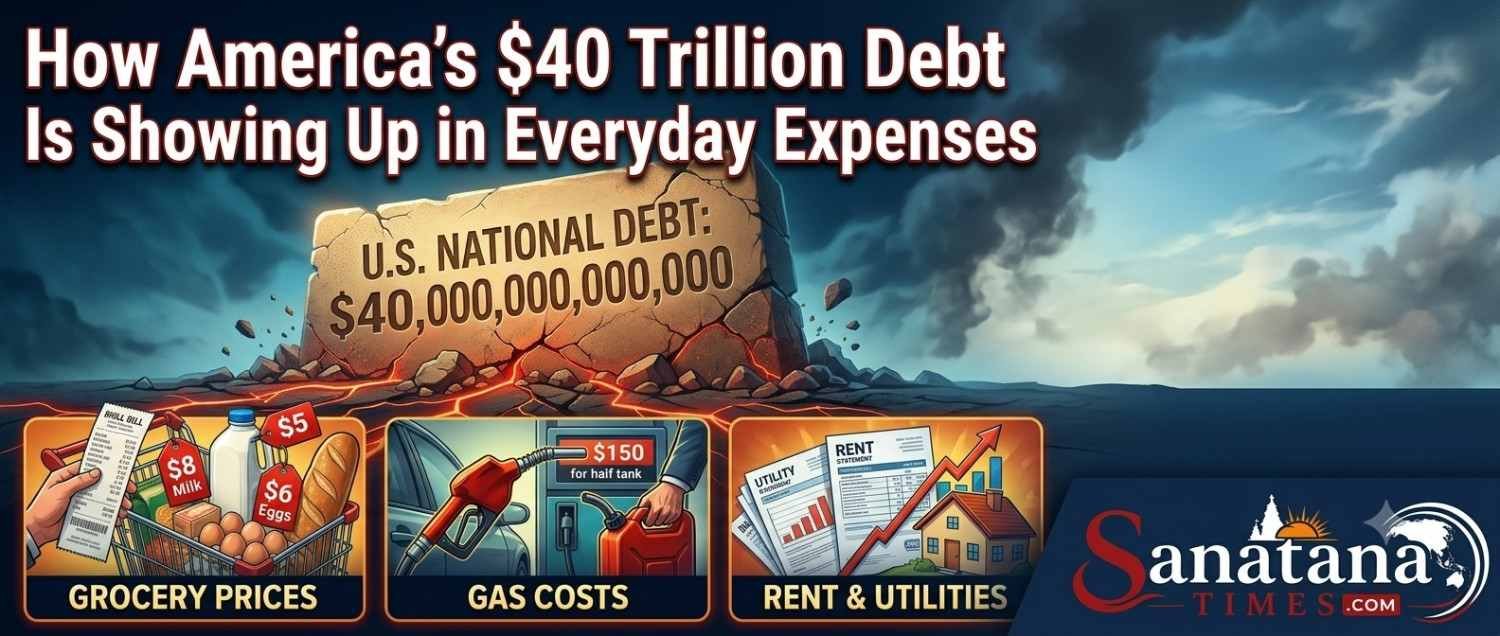
The huge national debt of the United States may appear to be a matter that is far removed from everyday life, being measured in trillions of dollars and generally dealt with by economists and policymakers. However, as the debt of the United States keeps rising, its effects are beginning to be felt in ordinary financial choices, such as mortgage rates, government spending and the cost of borrowing.
The federal debt has reached about $40 trillion, which is leading to increased focus being placed on the amount the government spends on interest payments. For households, the greater worry is not merely the extent of the debt, but rather what occurs when investors require higher interest rates in order to lend money to the government.
Why the national debt matters to households

When the federal government takes money on loan it has to pay interest on Treasury securities to the people who buy them. As the debt increases the government may have to pay ever larger amounts in interest.
The costs must be paid for by revenue from the federal government or by taking on more debt.
Higher government borrowing can also lead to pressure on interest rates since treasury yields act as a key benchmark for borrowing costs all over the economy and thus changes in government bond yields can affect mortgages, business loans and other types of credit.
For Americans who are attempting to buy a house, refinance their mortgage, or finance a large purchase, it can make a noticeable difference.
Mortgage rates can become more expensive
A clear way in which pressure from financial markets affects households is by means of mortgage rates.
Mortgage rates are affected by Treasury yields as well as people’s expectations regarding inflation and the policy of the Federal Reserve. If long-term Treasury yields go up, mortgage rates may also stay high.
For instance, if a household takes out a loan for buying a home amounting to hundreds of thousands of dollars it will end up paying a great deal more over the term of the loan when the interest rates are higher.
It means that the cost of the United States borrowing can have an indirect effect on how affordable it is to buy a house.
It also presents difficulties for current homeowners who are waiting for interest rates to drop before they refinance.
Credit cards and other loans feel the pressure
The impact of higher interest rates extends beyond mortgages.
When the cost of borrowing stays high, credit cards, car loans, personal loans and business financing all tend to become more expensive.
Credit-card interest rates are of particular significance since a great many consumers carry over their balances from month to month; even a fairly small rise in the cost of borrowing can result in annual interest charges for households that have a lot of revolving debt increasing by hundreds of dollars.
Businesses have a similar issue: higher financing costs can make expansion, the purchase of equipment or investment in new projects more expensive.
The higher costs may eventually affect prices, hiring decisions, and wages.
The government has less money available for other priorities
A very important issue is the quantity of money provided by the federal government to pay the interest on the national debt.
Any dollar that is spent on servicing existing debt is a dollar which cannot be used directly for other purposes unless further borrowing or increased revenue occurs.
This presents difficult decisions for those involved in policy-making.
The government can use its spending to fund a range of programs such as health care, infrastructure, education, defense and other services. However, as the amount spent on interest becomes a greater part of the federal budget, politicians are coming under more pressure to decide which of these programs should be funded.
For most Americans, those decisions will in the end influence the services and benefits that are available to them.
Might increased debt result in higher taxes?
Just because the debt is increasing doesn’t mean that taxes will have to go up. Yet if deficits continue they will eventually lead policymakers to think about some mix of cuts in spending, higher taxes or more borrowing.
If taxes increase, households may end up with less disposable income.
Businesses might also have to pay more in taxes, which could in turn affect the amount they invest and the number of people they hire.
The timing and extent of any such changes would be determined by future decisions made by Congress and the White House.
Inflation is another concern
Debt may as well become linked to expectations of inflation.
If investors think that the government will have to borrow a great deal over the next few years, they might ask for higher yields on Treasury bonds; and since the yields are higher, the government’s cost of borrowing increases and this can place extra pressure on financial markets.
Money’s ability to buy goods and services is reduced by inflation. Families may feel financially stressed even if the economy is growing, since prices for housing, food, transportation and other necessities are rising faster than household incomes.
The national debt is not the only reason why prices rise; they are influenced by a number of factors such as energy prices, supply chains, wages, monetary policy, and consumer demand.
What it means for the average American
The amount of forty trillion is hard to grasp since it has no relation to the financial situation of an ordinary household.
It is, however, much simpler to spot the consequences.
Americans may encounter the effects through:
Higher mortgage and borrowing costs
More expensive credit-card debt
Higher costs for business financing
Greater pressure on federal programs
Potential future tax increases
Increased financial-market volatility
Greater sensitivity to inflation and interest rates
The national debt does not directly add a specific sum to the monthly expenses of each family; rather, its effects travel through the financial system and the government budget, affecting the economic environment within which households make their decisions.
The bigger challenge ahead
The United States possesses huge financial resources and is still one of the largest economies in the world; therefore, the fact that it has a large debt does not necessarily indicate that an economic crisis is imminent.
The greater issue is the course it’s following.
If the level of debt keeps rising faster than the size of the economy over a long period of time, the amount needed to pay interest will occupy a larger and larger portion of government resources. When this happens, policymakers will have even fewer choices if the economy experiences a recession, a financial shock or a national emergency.
What concerns households is therefore not so much the sudden appearance one morning of a $40 trillion bill as it is the way that years of increasing debt can step by step affect borrowing costs, taxes, government services and the general cost of living.
Although America’s debt amounts to trillions, its effects can in the end be seen in the monthly budgets of average households.