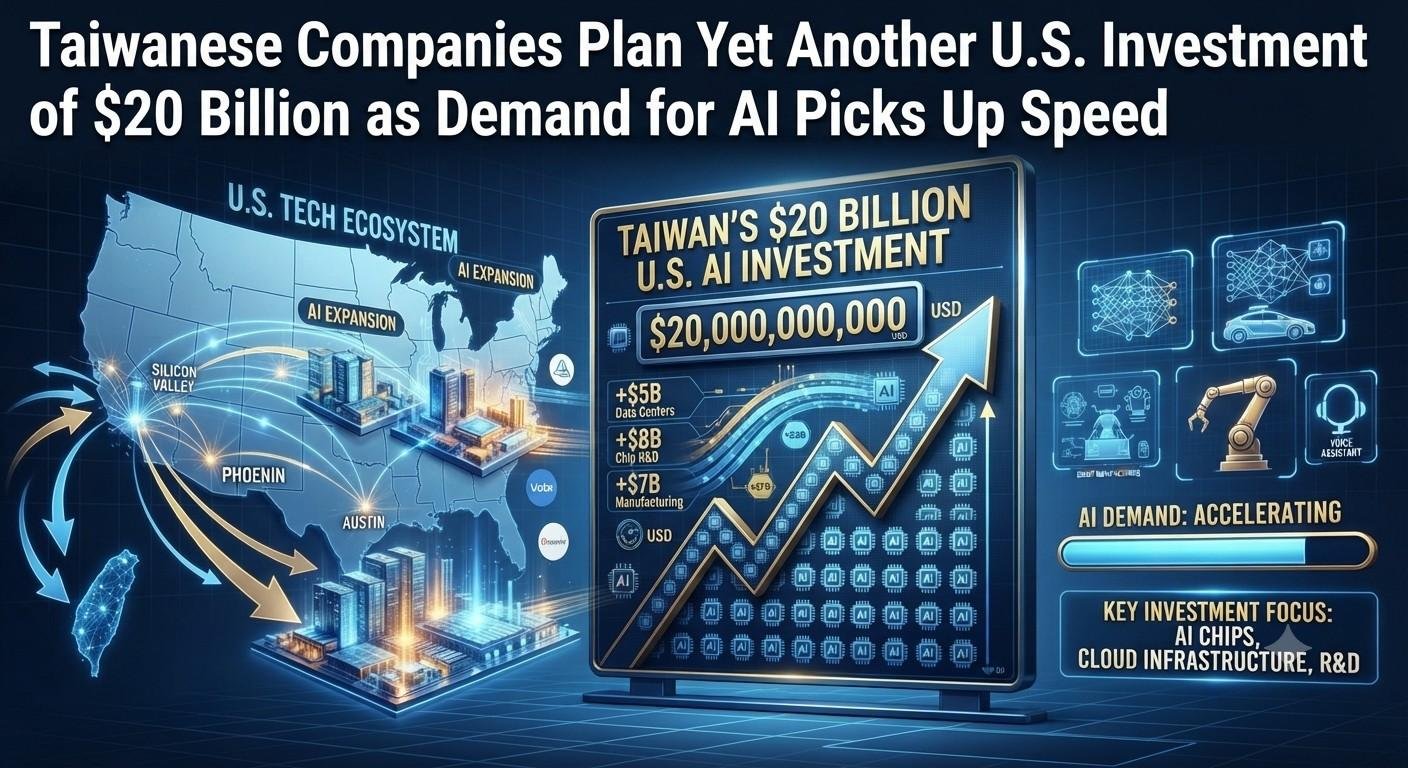
On Wednesday, September 2, 2026, Taiwan’s economy minister stated that Taiwanese companies are planning to make an extra investment of $20 billion in the United States, the reason being the rapidly increasing demand for artificial intelligence technologies and related products.
This planned investment occurs at a time when the global AI industry is still altering corporate spending, semiconductor supply chains and manufacturing strategies. Since Taiwan hosts a number of major companies which play an important role in the global technology ecosystem, the investment decisions made there are closely watched by both investors and policymakers.
The economy minister of Taiwan announced the additional investment plans without giving a detailed account of the companies concerned or of the specific projects. A U.S. official who was visiting welcomed the plans, stressing the importance of closer economic and technological cooperation between Taiwan and the United States.
AI Demand Drives Investment
Artificial intelligence is now one of the main factors affecting corporate capital expenditure around the world; the high demand for advanced computing, data centres, chips and AI infrastructure has led technology companies and their suppliers to increase their production capacity.
Taiwanese businesses have found the United States to be an ever more important place for investing, as they aim to place their manufacturing and supply chains nearer to their major customers and in response to changing trade policies.
The extra $20 billion would build upon the investment that Taiwan has already made in the United States and might strengthen the technological connections between the two economies.
Why the Investment Matters
The effects of the investment might extend beyond Taiwan and the United States. Since the production of semiconductors and the development of AI infrastructure involve huge amounts of capital, specialized machinery, and a large number of highly skilled workers, new projects can lead to increased demand in the fields of construction, engineering, logistics, technology, and professional services.
This announcement also shows a wider trend amongst Asian technology companies to expand their presence in the United States. Nowadays, these companies are increasingly weighing cost considerations against supply-chain resilience, market access and geopolitical risks.
For the United States, more foreign investment could be used to support domestic manufacturing capacity and help strengthen the supply chains that are considered strategically important to the technology sector.
Global Markets Remain Sensitive
At a time when global markets are facing considerable economic uncertainty, oil prices and the yields on government bonds have recently risen, together with growing concerns about inflation due to geopolitical tensions.
On September 2 the U.S. stock market showed signs of having recovered, the Dow Jones, the S&P 500 and the Nasdaq all advancing following their recent drops. While investors are still keeping a close eye on companies related to AI they are also looking at their expectations regarding interest rates and the effect of higher energy prices on the economy.
What Comes Next
The details regarding the planned $20 billion investment, together with the companies that will be taking part, the sites of the projects and the timelines, are expected to become better known when the various businesses announce their plans to expand.
Yet the move does send a clear message regarding the importance of the U.S. market to Taiwan’s technology industry, and since demand for AI is still affecting investment choices, the expansion of Taiwanese companies into America might turn out to be a significant event for the global semiconductor and technology supply chain.
The statement highlights a wider business trend in that artificial intelligence is not only affecting software and consumer products but is also having an impact on the locations that companies choose for their factories, on the way they expand their supply chains, and on the billions of dollars they invest in new capital.